
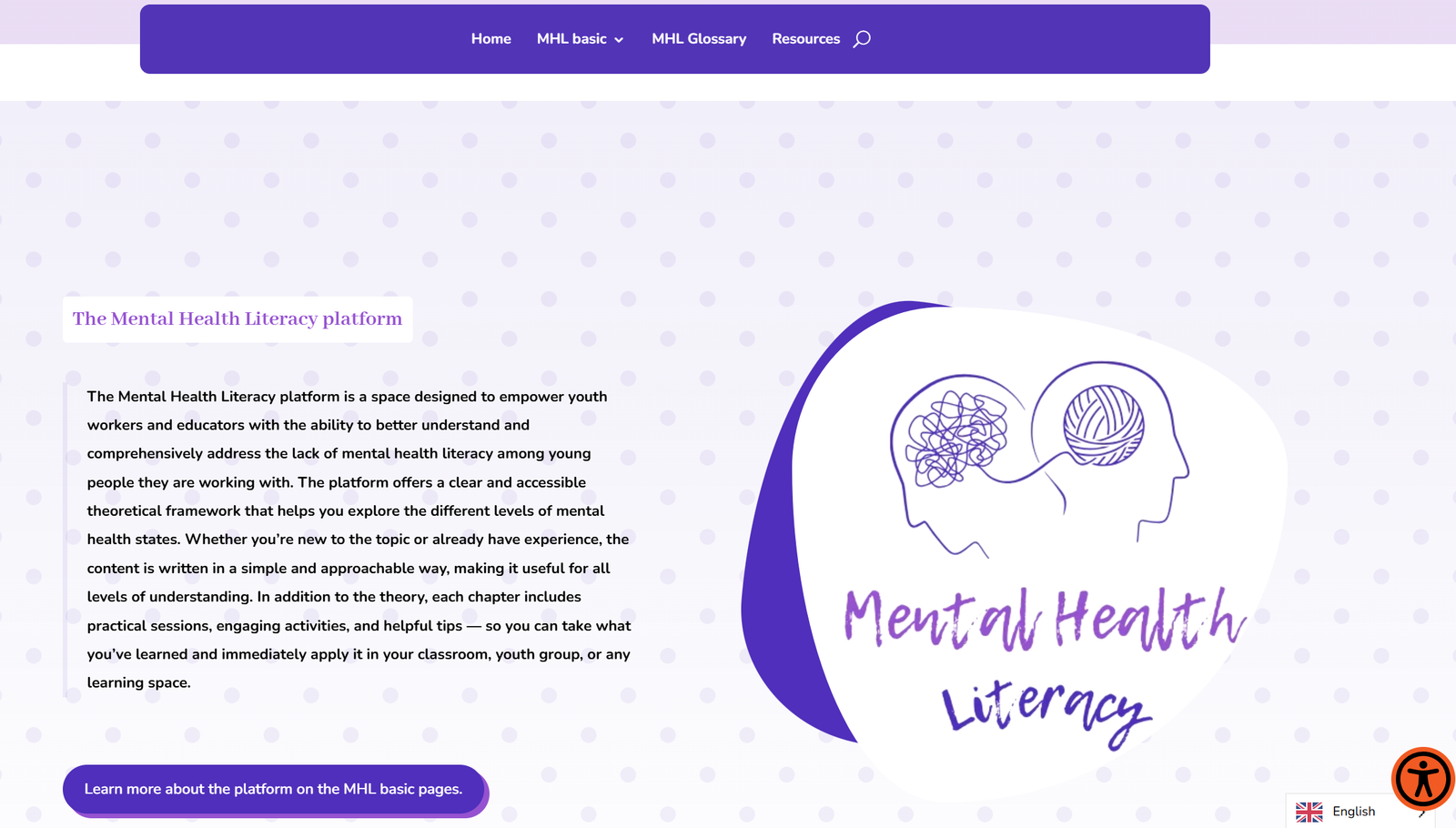
Mental health is no longer a topic we can afford to dance around — especially when working with young people. But knowing that mental health matters is very different from knowing how to talk about it, recognize warning signs, or actually help. That gap is precisely what the Mental Health Literacy platform (mentalhealthliteracy.net) was built to close.
What Is the Mental Health Literacy Platform?
The Mental Health Literacy (MHL) platform is a free, openly accessible educational resource developed as part of an Erasmus+ Cooperation Partnerships project in the field of youth. It is designed primarily for youth workers and educators who work with young people aged 18–26 across Europe, but the content is accessible and useful to anyone interested in mental health education.
The platform was developed by a consortium of four partner organizations from Serbia, Bulgaria, Germany, and Türkiye:
- Navissos (Serbia)
- ArTeam (Bulgaria)
- Highlights e.V. (Germany)
- Yengeç (Türkiye)
The project number is 2023-2-DE04-KA220-YOU-000184980, co-funded by the European Union.
The Problem That Couldn’t Be Ignored
The Core Idea: Shifting the Paradigm
One of the most refreshing aspects of this platform is its deliberate effort to move beyond the narrow, disorder-focused understanding of mental health. Most existing resources zoom in on severe conditions and clinical diagnoses. The MHL platform takes a broader view — it focuses on the full spectrum of mental health states, from everyday stress and mental distress all the way to diagnosable disorders.
This is captured in what the platform calls the MHL Pyramid — a conceptual model with four levels:
- No distress, problem, or disorder — the largest group; people with generally stable mental well-being
- Mental distress — temporary emotional discomfort caused by everyday stressors; completely normal
- Mental health problem — a broader term for when someone’s thoughts, emotions, or behavior are negatively affected over a sustained period, without necessarily meeting diagnostic criteria
- Mental disorder/illness — a clinically diagnosable condition defined by standardized criteria (DSM-5 or ICD-11), requiring professional treatment
This framework is genuinely useful in youth work, where most of what we encounter sits in the bottom two tiers — and where early, non-clinical intervention can make all the difference.
What the Platform Actually Contains
The content is organized into three main areas: Recognition, Prevention, and Management.
Recognition
This section helps youth workers understand and identify different mental health states — not just disorders, but the subtler signs of distress and struggle that young people often display. It also covers the attitudes that either support or hinder young people from seeking help, and how workers can foster a more open environment.
Prevention
Prevention is broken down across three levels:
- Primary prevention — stopping mental health problems before they start
- Secondary prevention — supporting those at higher risk
- Tertiary prevention — helping those already living with mental health challenges to stay well
The section also addresses one increasingly relevant area: addictive behavior related to screens, smartphones, and social media, including statistics on global usage patterns and practical strategies youth workers can use with young people.
Management
The management section covers both professional help and self-care. It explains who’s who in mental health professions, how to recognize when a young person might need professional support, and crucially — what to say (and what not to say) when someone opens up. There are also practical scenario cards for training purposes.
The self-care content covers coping mechanisms, including how to recognize unhealthy coping patterns, and specific strategies for managing anxiety and stress.
Language Matters: The Stigma-Free Approach
One section that stands out is the platform’s focus on language-appropriate communication. It acknowledges that one of the biggest barriers to mental health support is the misuse of terminology — words borrowed from clinical contexts that get thrown around casually, often reinforcing stigma rather than reducing it.
The platform provides:
- A glossary of key MHL terms
- Examples of preferred vs. problematic language
- A downloadable handout for use in youth work practice
This is practical, immediately usable material. Anyone running workshops with young people will find it directly applicable.
Who Is It For?
The platform explicitly targets youth workers and educators — people who are not therapists or clinical professionals, but who are often the first point of contact when young people are struggling. The content is written in accessible, jargon-light language and includes practical activities, session guides, and tips that can be implemented directly in a youth center, school, sports club, or non-formal learning setting.
It is also available in multiple languages — English, Serbian, Bulgarian, and German — making it genuinely usable across the partner countries and beyond.
Why This Platform Matters for the Erasmus+ Community
If you work in Erasmus+ youth projects, this platform is particularly relevant. Mental health has become a horizontal priority across multiple key actions, and integrating it meaningfully into youth work — beyond a checkbox — requires actual knowledge and tools. The MHL platform offers exactly that: a structured, evidence-informed, youth-work-adapted approach to mental health education.
It is also a model worth studying from a project output perspective. The platform is well-structured, multilingual, practically oriented, and clearly designed with the end user — the youth worker in the field — in mind.
Check It Out
The Mental Health Literacy platform is live at mentalhealthliteracy.net and completely free to use. Whether you’re building your own mental health literacy skills, looking for workshop materials, or simply want a reliable reference for terminology and frameworks — it’s worth bookmarking.
Mental health literacy isn’t a specialist skill reserved for psychologists. It’s something every person working with young people can and should develop. Platforms like this one make that a realistic goal.
0 Comments